I am learning flutter from JustAcademy, They provide very much great environment where people gather and work simultaneously. totally project based training institute.
MOHD ABU BAKAR ANSARI
Flutter Developer
Awesome Experience. I am a Front-end Web Designer working at Star India for 3 years now. I applied for Full-stack development and my experience has been phenomenal & they really do help with placements exceptionally. Thank you Roshan sir so much.
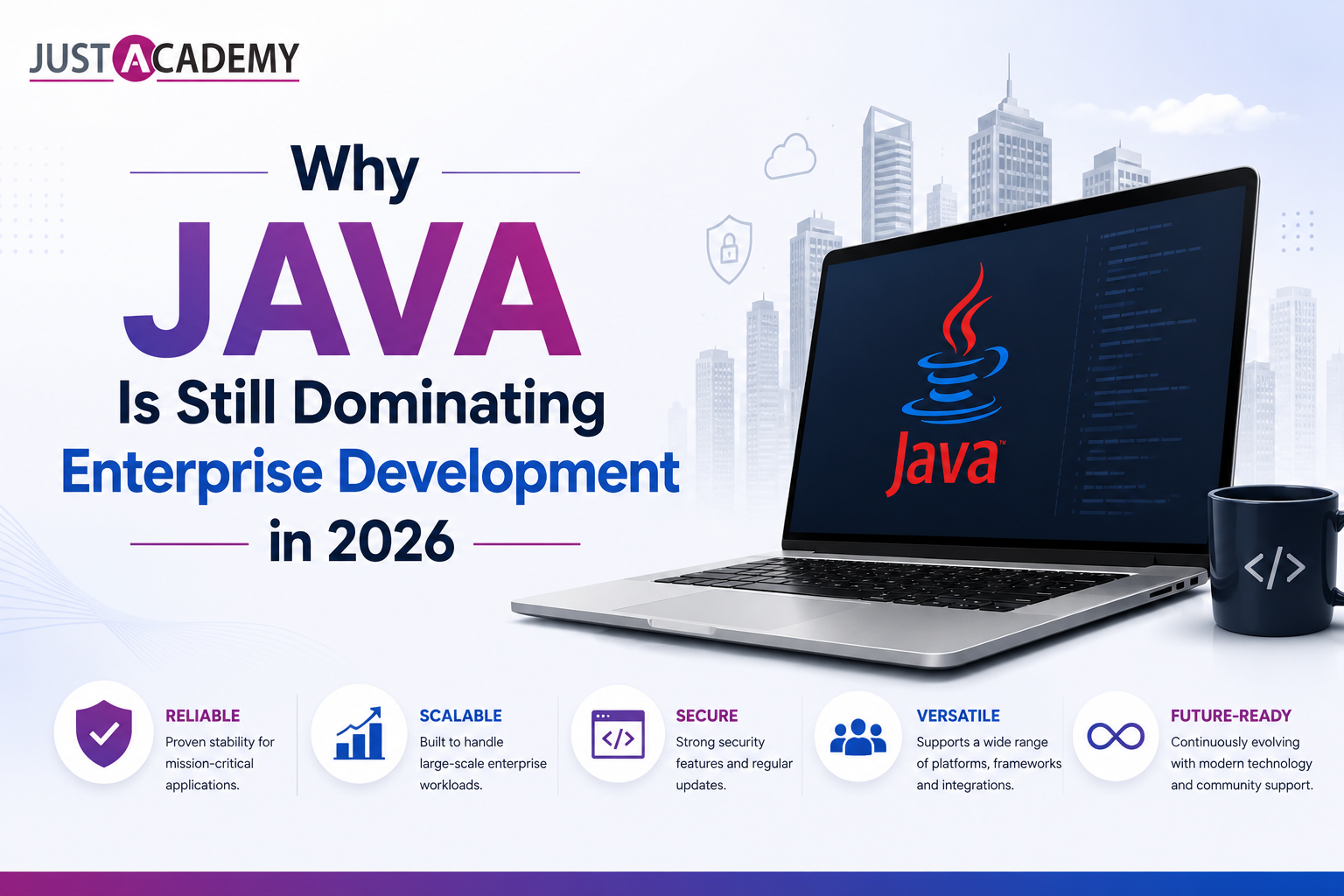
Every few years, a new programming language or framework generates enough excitement that technology commentators declare Java is finally on its way out. Go will replace it for backend services. Python will take over enterprise data processing. Kotlin will supersede it on the JVM. Node.js will displace it for web services. And yet in 2026, Java remains the most widely deployed enterprise programming language in the world by virtually every meaningful metric. It runs the core banking systems of nearly every major Indian bank. It powers the transaction processing infrastructure of global e-commerce platforms. It underpins the healthcare IT systems of hospitals and insurance companies across multiple continents. And it continues to be the primary language choice for new enterprise development projects at IT services companies, product organizations, and financial institutions across India.
This is not nostalgia or organizational inertia, though those factors play a role. Java's continued dominance in enterprise development in 2026 has specific, defensible technical and business reasons that are worth understanding deeply. For developers choosing where to invest their career, understanding why companies still use java in 2026 provides clear guidance on where the most stable and best-compensated opportunities remain. For technology decision-makers, understanding Java's genuine strengths helps explain why replacing it with newer languages rarely delivers the expected benefits. And for students and freshers evaluating which backend language to learn, understanding Java's enterprise position is essential context for a career decision that will shape the next decade of professional opportunities.
Why Java Has Remained the Backbone of Enterprise Development for Decades
The JVM Is an Extraordinary Engineering Achievement
The Java Virtual Machine is the technical foundation of Java's enterprise dominance and its capabilities go far beyond what most developers who use it daily fully appreciate. The JVM's Just-In-Time compiler does not simply execute bytecode. It continuously profiles running application behavior, identifies the hottest code paths, and compiles them to highly optimized native machine code that can outperform the equivalent C code for long-running server applications where the JIT has had time to optimize. This adaptive compilation means that a Java enterprise application running under production load often performs better than the same application would if compiled statically ahead of time, because the JIT can specialize compiled code for the actual data patterns encountered at runtime.
The JVM's garbage collector has evolved over three decades into a sophisticated set of collection strategies that allow enterprise applications to run for months without manual memory management while maintaining predictable latency profiles. G1GC, ZGC, and Shenandoah GC provide pause times measured in milliseconds even for heap sizes of hundreds of gigabytes. This level of memory management maturity is simply not available in most newer languages and represents an enormous operational advantage for systems that must maintain high availability around the clock.
Platform Independence That Still Matters
Write once run anywhere was Java's original promise and while the industry has largely moved to containerized deployment that makes this less of a differentiating factor than it once was, the JVM's platform independence still provides genuine operational value. Large enterprises with heterogeneous infrastructure spanning multiple operating systems, hardware architectures, and cloud providers can deploy the same Java application binary across all environments without recompilation. In practice this means that a Java enterprise application developed and tested on macOS developer machines can be deployed to Linux production servers on AWS, Azure, or GCP without any platform-specific concerns. Docker and containerization have extended this benefit rather than replacing it, with Java applications containerized and deployed consistently across any container runtime.
The Ecosystem Depth That No Other Language Matches
Java's enterprise ecosystem has been accumulating for thirty years and the depth of that accumulation is difficult to overstate. Spring Boot for web application and microservices development. Hibernate and Spring Data JPA for enterprise-grade ORM. Apache Kafka for distributed event streaming. Elasticsearch for search and analytics. Apache Spark for big data processing. Quarkus and Micronaut for cloud-native optimized runtimes. Jakarta EE for enterprise application standards. Gradle and Maven for sophisticated build and dependency management. JUnit, Mockito, and Testcontainers for comprehensive testing. Micrometer for application observability. And thousands of battle-tested libraries covering every enterprise requirement from PDF generation to cryptography to distributed caching.
This ecosystem depth means that when an enterprise developer encounters a requirement, there is almost certainly a mature, well-tested, well-documented Java library that addresses it. This reduces the development and maintenance risk of enterprise software in ways that are genuinely valuable to organizations building systems that must operate reliably for decades.
Backward Compatibility as a Business Value
One of Java's most underappreciated enterprise strengths is its commitment to backward compatibility. Java code written in 2001 can still compile and run on the latest JVM with minimal modification. This is not an accident. It is a deliberate design principle that reflects the reality of enterprise software where systems cannot simply be rewritten every time the runtime evolves. Banks run Java applications that have been in production for fifteen years. Insurance companies have policy administration systems that have been incrementally enhanced rather than replaced. Logistics platforms have order management systems built on Java codebases that have evolved continuously since their initial deployment.
The cost of maintaining this backward compatibility is real. Java evolves more conservatively than newer languages. Some language features that developers enjoy in Kotlin, Scala, or Python are only slowly adopted in Java. But for enterprises where rewriting working systems carries enormous cost and risk, the guarantee that today's Java investment remains viable for the next decade is a feature not a limitation.
Key Reasons Companies Still Choose Java for Enterprise Applications in 2026
Performance at Scale
Java's performance characteristics make it the appropriate choice for high-throughput enterprise applications where the volume of transactions is too large for interpreted or less optimized runtimes to handle efficiently. Indian banks processing millions of financial transactions daily, stock exchanges handling thousands of orders per second, and e-commerce platforms serving millions of concurrent users all rely on Java's performance profile to meet their throughput and latency requirements.
Modern Java with Project Loom's virtual threads, introduced as a stable feature in Java 21, has dramatically improved Java's concurrency model. Virtual threads allow hundreds of thousands of concurrent lightweight threads without the resource overhead of traditional OS threads, directly addressing one of the main arguments that Node.js and Go advocates made against Java for high-concurrency scenarios. Java 21's virtual threads enable performance characteristics in server applications that match or exceed competing runtimes while retaining the full richness of the Java ecosystem.
The Talent Market Is the Largest in the World
Enterprise technology decisions are not made purely on technical merit. They are also made based on talent availability. Java has the largest pool of enterprise developers globally and the second largest pool of developers overall after JavaScript. In India specifically, Java is the primary language taught in engineering curricula across hundreds of engineering colleges, the primary language used by the largest IT services companies including TCS, Infosys, Wipro, HCL, and Cognizant, and the primary requirement in the majority of senior backend developer job postings.
This talent market depth means that an enterprise choosing Java for a new system is choosing a technology stack for which they can find, hire, and retain developers indefinitely. An enterprise choosing a newer or less popular technology must compete for a smaller talent pool, pay a scarcity premium, and accept higher turnover risk. For organizations building systems intended to run for ten or twenty years, talent availability is a genuine strategic consideration that consistently favors Java.
Enterprise-Grade Security and Compliance
Financial services, healthcare, insurance, and government organizations operate under strict regulatory frameworks that impose specific requirements on their technology systems. Java's security architecture, its mature cryptography libraries, its established patterns for implementing authentication, authorization, and audit logging, and its well-understood compliance characteristics have made it the trusted choice for regulated industries across multiple decades.
The Java Security Manager, though deprecated in recent versions in favor of more modern security approaches, demonstrated a security consciousness in the platform's design that permeates the ecosystem. Spring Security provides one of the most comprehensive authentication and authorization frameworks available for any language, covering everything from basic form login through OAuth2, JWT, SAML, and multifactor authentication. For organizations with strict security requirements, using a platform with thirty years of security hardening and an ecosystem designed around enterprise security patterns reduces both implementation risk and audit complexity.
Microservices and Cloud-Native Java in 2026
One of the most common misconceptions about Java in enterprise development is that its history with heavy application servers makes it unsuited for modern cloud-native microservices architecture. The reality in 2026 is almost the opposite. Spring Boot became the dominant framework for building microservices precisely because it makes creating lightweight, self-contained Java services faster and simpler than any comparable framework in any language. A Spring Boot application can be containerized, deployed to Kubernetes, and scaled horizontally with the same operational tooling as any other container-based service.
Quarkus and Micronaut are Java frameworks specifically optimized for cloud-native deployment with startup times measured in milliseconds and memory footprints measured in tens of megabytes. These frameworks compile Java applications to native executables using GraalVM Native Image, producing startup and memory characteristics that match Go and surpass most other runtimes. For enterprise organizations that want the Java ecosystem's richness with cloud-native operational characteristics, these frameworks provide exactly that combination.
Spring Boot: The Framework That Reinvigorated Enterprise Java
Spring Boot deserves specific credit for maintaining Java's enterprise relevance in 2026. When developers from other languages claim that Java is verbose and configuration-heavy, they are often describing the Java enterprise development experience of ten to fifteen years ago. Spring Boot's convention-over-configuration approach means that a Java developer in 2026 can create a production-ready REST API with database connectivity, security, and monitoring in the same amount of code that the equivalent in other frameworks requires. The combination of auto-configuration, embedded servers, the Spring Initializr project generator, and the extensive starter library ecosystem has made Spring Boot one of the most productive backend development frameworks available in any language.
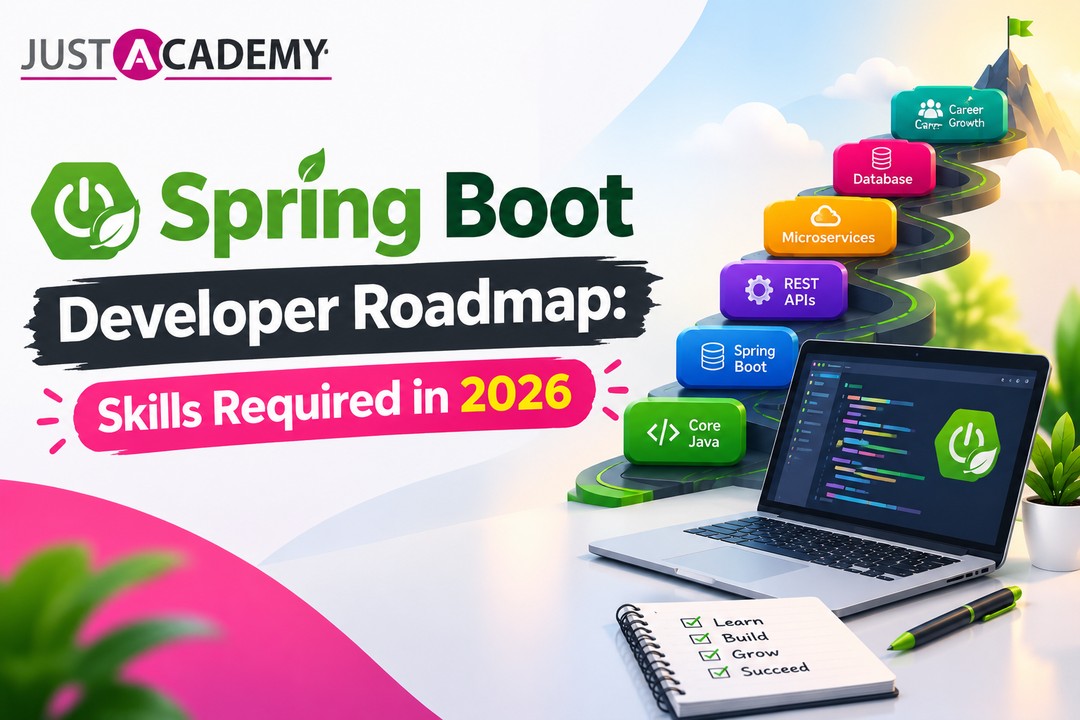
Spring Boot adoption in India is effectively universal among enterprise Java teams. Banking core systems, insurance platforms, logistics management applications, HR management systems, and countless other enterprise applications built in the last five years use Spring Boot as their backend framework. For Java developers in India in 2026, Spring Boot proficiency is not a specialization but a baseline professional expectation.
Java's Concurrency Model Has Been Transformed
Historically, Java's threading model was a genuine limitation for building highly concurrent servers compared to languages with event-loop architectures like Node.js or Go's goroutines. Java 21's Project Loom virtual threads fundamentally changed this. Virtual threads are lightweight JVM-managed threads that can be created in millions without the resource overhead of OS threads. They integrate seamlessly with existing Java code, blocking operations in a virtual thread do not block the underlying OS thread, and they require no changes to the familiar sequential programming model.
This means that enterprise Java developers can now write straightforward sequential code that scales to handle massive concurrency without the complexity of reactive programming models or callback-based async patterns. The latency and throughput characteristics of Java applications using virtual threads match or exceed those of Go and Node.js for typical enterprise workloads while retaining the full Spring Boot ecosystem and all existing Java libraries without modification.
The Cost of Migrating Away From Java
Organizations with existing Java enterprise systems face a migration calculation that consistently favors continuing to invest in Java rather than rewriting in a different language. Rewriting a large enterprise system is one of the highest-risk activities in software development. History is full of migration projects that took three times as long as planned, cost five times the original estimate, introduced thousands of new bugs, and ultimately produced a system no better than the one it replaced. The famous Second System Effect and the risks of big-bang rewrites are well-understood by experienced technical leaders.
For most enterprises, the appropriate strategy is to continue developing Java applications with modern Java practices, Spring Boot, and cloud-native deployment patterns rather than incurring the substantial cost and risk of migrating to a different language. This organizational reality ensures that Java's enterprise presence persists and grows even when technical teams express preference for newer languages.
Java in Enterprise India: Industries and Use Cases Driving Demand
Banking and Financial Services
India's banking sector is perhaps the largest single driver of Java enterprise development in the country. Public sector banks, private sector banks, payment companies, and non-banking financial companies all run core banking systems, payment processing infrastructure, loan origination platforms, and regulatory reporting systems built primarily on Java. The Reserve Bank of India's regulatory requirements, the real-time gross settlement system, and the Unified Payments Interface infrastructure that processes hundreds of millions of transactions daily are all built on Java-based platforms.
Java's combination of high throughput, strong typing for financial calculations, mature transaction management through Spring's Transactional annotation and JPA, comprehensive security infrastructure, and the availability of specialized financial libraries makes it the natural choice for systems where a single programming error could mean millions of rupees in financial exposure.
Insurance and Healthcare
Insurance companies manage complex policy administration, claims processing, actuarial calculation, and regulatory reporting requirements that demand exactly the characteristics Java provides. Policy premium calculations involving hundreds of parameters, claims workflows spanning months and multiple departments, and regulatory submissions requiring perfect audit trails are all domains where Java's type safety, transaction management, and long-term ecosystem stability provide genuine value.
Healthcare IT including hospital management systems, electronic health records, insurance claims adjudication, and clinical trial data management are similarly well-served by Java's enterprise characteristics. The sensitivity of patient data and the regulatory requirements of healthcare compliance make Java's security maturity particularly relevant in this sector.
Logistics and Supply Chain
India's logistics sector has undergone massive technology transformation over the last decade and Java powers much of it. Warehouse management systems, fleet tracking platforms, order management engines, and supply chain visibility solutions built by companies serving India's growing e-commerce and manufacturing sectors overwhelmingly use Java backends. The need to process millions of shipment events daily, integrate with dozens of third-party carrier systems, and maintain audit trails for compliance all favor Java's ecosystem depth and processing efficiency.
IT Services and Global Delivery
India's IT services industry is the largest single employer of Java developers in the world. TCS, Infosys, Wipro, HCL, Cognizant, and hundreds of mid-tier IT services companies maintain massive Java practices serving enterprise clients in the United States, Europe, and globally. These practices build and maintain core banking systems, insurance platforms, healthcare applications, retail management systems, and enterprise resource planning integrations. The demand for Java developers from India's IT services sector is structural and predictable, growing steadily with the growth of the companies themselves.
The Java Developer Salary Trajectory in India
Java developer compensation in India in 2026 reflects the continued strength of enterprise demand and the genuine scarcity of developers with deep Spring Boot and enterprise Java expertise.
Role
Salary Range India 2026
Junior Java Developer 0 to 2 years
4 to 8 LPA
Java Developer 2 to 4 years
8 to 16 LPA
Senior Java Developer 4 to 7 years
16 to 28 LPA
Java Tech Lead 7 to 10 years
26 to 42 LPA
Java Architect 10 plus years
38 to 65 LPA and above
Spring Boot Microservices Specialist
15 to 35 LPA at mid to senior level
Developers who combine strong Core Java fundamentals with Spring Boot expertise, microservices architecture knowledge, cloud platform familiarity, and domain expertise in banking, insurance, or healthcare command salaries at the top of these ranges and face competition for their services from multiple employers simultaneously.
Java Versus the Competition in Enterprise Contexts
Java Versus Python
Python has become the dominant language for data science, machine learning, and data analytics applications. In these domains, Python's ecosystem advantages through NumPy, Pandas, TensorFlow, PyTorch, and scikit-learn are decisive and Java is not seriously competitive. However, for transaction processing, business logic implementation, and enterprise web services where Java's type safety, performance, and ecosystem depth provide genuine advantages, Java remains the stronger choice. In 2026, many enterprises use both languages with Python for analytics and data pipelines and Java for transaction processing and business applications, rather than choosing one over the other for all purposes.
Java Versus Kotlin
Kotlin runs on the JVM and is fully interoperable with Java, meaning Java and Kotlin can coexist in the same codebase. Kotlin's more concise syntax, null safety built into the type system, and modern language features address many of the verbosity criticisms historically leveled at Java. Kotlin adoption in enterprise Java development has grown steadily, particularly for new code written alongside existing Java codebases. However, most large enterprise Java systems remain primarily Java codebases, and the enterprise job market continues to specify Java rather than Kotlin in the vast majority of senior backend developer postings. Learning Java remains the correct starting point for enterprise backend development in India in 2026.
Java Versus Go
Go is genuinely strong for building high-performance network services and infrastructure tooling. Its simple concurrency model with goroutines and channels, fast compilation, and small binary sizes have made it the preferred language for cloud infrastructure tools, DevOps tooling, and certain categories of high-performance services. However, Go's ecosystem is significantly thinner than Java's for enterprise business applications. Financial calculation libraries, enterprise ORM, comprehensive security frameworks, workflow engines, and the thousand other enterprise requirements that Spring's ecosystem addresses are either absent or less mature in Go's ecosystem. Large Indian enterprises building business applications have not meaningfully adopted Go as a primary language for core business systems.
How to Build a Strong Java Enterprise Career With the Best Training in 2026
The Skills That Define Enterprise Java Expertise
Building a strong Java enterprise career in 2026 requires depth across several interconnected skill areas. Core Java mastery including object-oriented design, Java 8 and modern features, collections, concurrency, and exception handling is the foundation. Spring Boot proficiency covering REST API development, Spring Data JPA, Spring Security, and Spring Cloud is the daily working requirement for almost every enterprise role. Database design and SQL fluency because enterprise Java developers work with relational databases constantly and must understand the database layer not just the ORM. Microservices architecture principles and their Spring Cloud implementation because most new enterprise systems are built as microservices. Docker and Kubernetes familiarity because enterprise Java applications are deployed in containers. Testing with JUnit and Mockito because enterprise code quality requires comprehensive test coverage. And increasingly, cloud platform knowledge because enterprise Java applications run in AWS, Azure, or GCP.
Why Structured Training Produces Enterprise-Ready Java Developers
Enterprise Java development involves a large number of interconnected frameworks and patterns that are genuinely difficult to develop systematic competency in through self-directed learning. Understanding why Spring Boot's auto-configuration works the way it does requires understanding the Spring IoC container. Understanding why Hibernate's lazy loading causes LazyInitializationException outside a transaction requires understanding the JPA entity lifecycle. Understanding why JWT authentication fails silently requires understanding the Spring Security filter chain. These interconnections are learned most efficiently through structured curriculum with expert guidance and real project work rather than through isolated tutorials that cover each component separately.
JustAcademy's Java training programs are built around the complete enterprise Java skill set that Indian employers are hiring for in 2026. The curriculum progresses from Core Java fundamentals through advanced Java features, Spring Boot backend development, Spring Data JPA and Hibernate, Spring Security and JWT, microservices with Spring Cloud, and deployment with Docker and cloud platforms. Live interactive sessions with experienced instructors who have built real enterprise Java applications provide the guidance that transforms knowledge into genuine capability.
For learners in Maharashtra who want the best Java training in Mumbai with classroom-based learning, live project development, and direct connections to Mumbai's strong enterprise Java job market, Core Java Training in Mumbai and Advance Java Training in Mumbai are the programs built for exactly that outcome. Live interactive classroom sessions, instructor code reviews on real enterprise projects, and placement support connecting graduates to banking, IT services, and product company roles in Mumbai give learners a significant advantage in competitive hiring processes.
For learners anywhere in India or globally who want live interactive Java enterprise training with the flexibility of remote learning, Core Java Online Training and Advance Java Online Training deliver the same curriculum quality, project depth, and placement support from any location.
For Java developers who want to strengthen the frontend and full stack dimensions of their profile alongside enterprise Java backend skills, JustAcademy also offers:
Related Courses to Complete Your Enterprise Technology Profile
Building skills beyond core Java into adjacent enterprise technologies increases your versatility and career trajectory significantly. Explore these programs at JustAcademy:
Java's continued dominance of enterprise development in 2026 is not a historical accident or organizational inertia. It reflects genuine technical strengths that newer languages have not yet matched in the enterprise context. The JVM's extraordinary performance optimization, the Spring Boot ecosystem's development productivity, the platform's thirty years of security hardening, the backward compatibility that protects multi-decade technology investments, the depth of enterprise-specific libraries covering every requirement, and the talent pool depth that makes Java skills perpetually hireable are collectively a compelling case for Java's continued primacy.
For Indian developers evaluating where to invest their career, the picture is clear. Banking, financial services, insurance, healthcare, logistics, IT services, and enterprise software organizations in Mumbai, Bangalore, Hyderabad, Pune, and across India continue to build their most critical systems on Java. The salaries for senior Java developers with Spring Boot, microservices, and domain expertise reflect genuine scarcity and consistent demand. And the Java ecosystem continues to evolve actively with Project Loom virtual threads, modern language features in Java 21 and beyond, and cloud-native frameworks like Quarkus that extend Java's relevance for the next decade of enterprise development.
The right time to build enterprise Java skills was five years ago. The second best time is today.
Take the first step toward your enterprise Java career with JustAcademy. Register for a Free Demo to experience the Java enterprise curriculum firsthand and speak with an advisor about the fastest path to your Java developer career, or Download the Brochure to review course content, batch schedules, and fees before you decide.
For classroom-based learning in Maharashtra with live interactive sessions and local industry connections, Core Java Training in Mumbai and Advance Java Training in Mumbai are the programs that build genuine enterprise Java careers. For learners anywhere in India or globally, Core Java Online Training and Advance Java Online Training deliver the same quality from wherever you are. Java is still dominating enterprise development in 2026. Build the skills that dominating industries demand.
Why Java Has Remained the Backbone of Enterprise Development for Decades
Key Reasons Companies Still Choose Java for Enterprise Applications in 2026
Java in Enterprise India: Industries and Use Cases Driving Demand
How to Build a Strong Java Enterprise Career With the Best Training in 2026
A practical, human guide for Delhi freshers and working professionals who want to walk into every technical, design and HR round with real confidence, backed by live interactive, instructor led and mentor led sessions.
A practical, honest guide to frontend developer skills, the roadmap that actually works, and how live instructor led and mentor led training can get you hired
A practical, no fluff guide to the front end developer skills Delhi employers test for, and how mentor led, live interactive training helps you build them.
A practical, example driven guide to ES6 JavaScript for learners in Delhi who want to write modern code, think like a developer and get job ready with live instructor led and mentor led training
From your first Angular app to real time dashboards, here is a practical, mentor backed list of angular projects for practice, with source code thinking, live interactive sessions and placement support.
From a humble to do list to a Node JS backend, here are the javascript project ideas that actually teach you something and give recruiters a reason to click your GitHub link.
A straight talking guide for Delhi freshers, career switchers and non tech graduates on choosing the right IT certification, and why live interactive, instructor led and mentor led training makes the difference
Drop us a Query
+91 99871 84296
Available 24x7 for your queries
Want To Connect with us
🚀 Kickstart Your IT Career
with JustAcademy
Learn Industry-Focused Courses with Live Projects & Placement Assistance
Full Stack Java(Java, Spring Boot, Hibernate, REST API, React JS)
Data Analytics(Excel, SQL, Power BI, Python, Tableau)